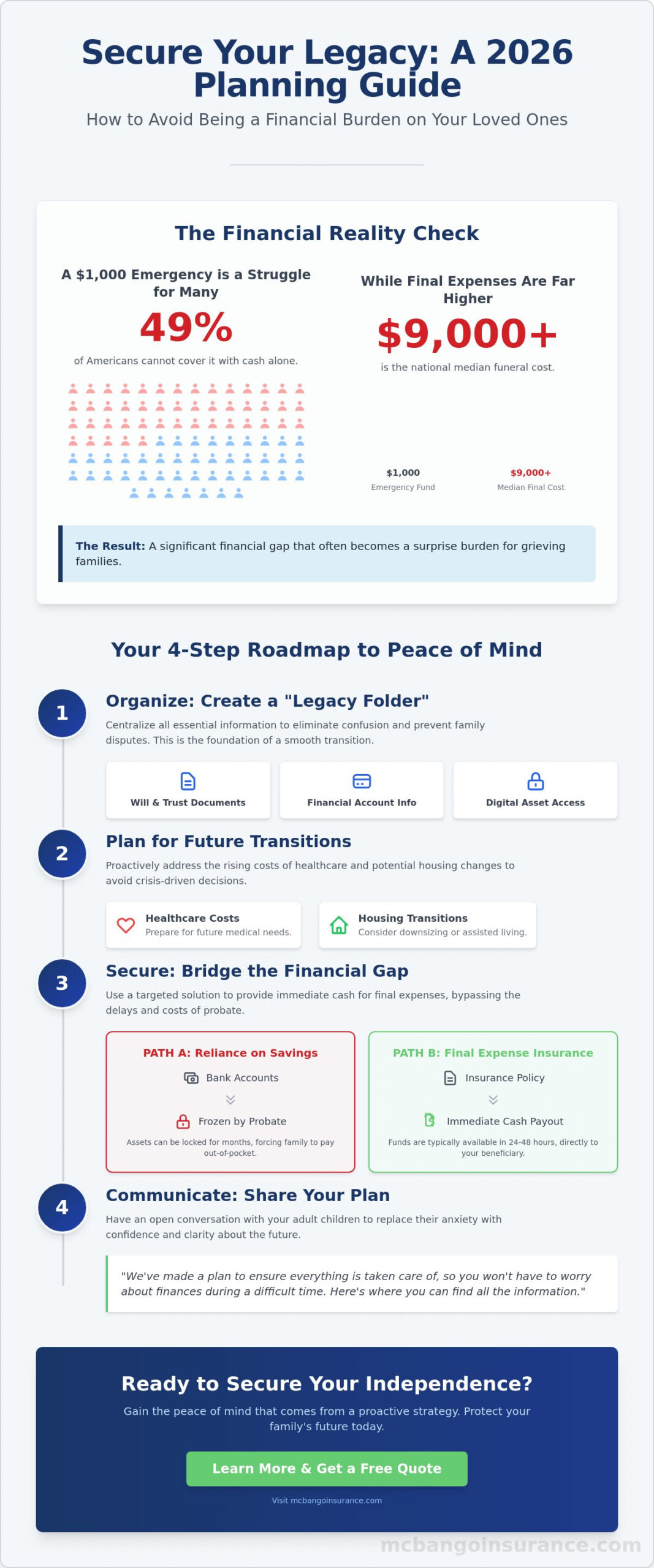
Did you know that 49% of Americans couldn’t cover a $1,000 emergency with cash alone? When you combine that reality with national median funeral costs now exceeding $9,000, it’s natural to feel a sense of urgency about your legacy. Learning how to avoid being a financial burden on your family starts with a shift in perspective. You’re moving from simply managing your 401(k) to creating a comprehensive safety net for those you love.
You’ve worked hard to build a life of independence. The last thing you want is for your children to inherit debt or difficult financial decisions during a time of grief. It’s a heavy weight to carry, especially with rising costs and the complexity of modern estate rules. We understand that you want to protect your family’s future while maintaining your own security and dignity.
This 2026 planning guide provides a step-by-step roadmap to securing your independence and protecting your loved ones from unexpected end-of-life expenses. We’ll walk through a clear checklist of essential documents, explain how to find an affordable insurance plan for final costs, and help you gain the peace of mind that comes with a proactive strategy.
Key Takeaways
- Learn how to identify the specific financial gap between your current liquid assets and 2026 end-of-life costs to prevent “surprise” expenses for your children.
- Organize your legal and digital assets into a “Legacy Folder” to ensure your family can navigate probate and account access without unnecessary stress.
- Discover how to avoid being a financial burden on your family by planning ahead for the rising costs of housing and healthcare transitions.
- Compare tailored insurance solutions like Final Expense coverage that provide immediate cash for funeral costs and other final liabilities.
- Gain a practical script for discussing your financial plans with your adult children to replace anxiety with confidence and clarity.
What Does it Mean to Be a Financial Burden in 2026?
In 2026, being a “financial burden” isn’t a reflection of your character; it’s a technical gap between your final needs and your available liquid assets. When a person passes away without clear funding, their adult children often face “surprise” expenses that can derail their own financial stability. This burden goes beyond the dollar amount. It creates a period of intense emotional stress where family members must make high-stakes financial decisions while they’re grieving. Understanding how to avoid being a financial burden on your family requires focusing on three pillars: managing existing debt, planning for future care transitions, and securing immediate funds for final expenses.
To better understand this concept, watch this helpful video:
Waiting for a health crisis to spark these conversations is the most common mistake people make. By the time a crisis occurs, your options are often limited and much more expensive. Proactive planning ensures that your family isn’t left guessing what you would have wanted or scrambling to find the cash for immediate costs. True independence means you’ve handled the logistics so your loved ones can focus on your legacy rather than your liabilities.
The Rising Cost of Finality in Florida
Florida is seeing unique trends in 2026 that affect your planning. While cremation remains a popular choice for its perceived lower cost, the price of professional services and urn placements continues to rise with inflation. Traditional burials in the Sunshine State face even steeper climbs due to land scarcity in popular coastal areas. If you rely solely on a standard savings account to cover these costs, your family may run into a “liquidity trap.” Because Florida’s probate process can be lengthy, your bank accounts might be frozen for months, leaving your children to pay for the funeral out of their own pockets while they wait for the estate to settle.
Identifying Your Personal Vulnerabilities
To see where you stand, ask yourself a few honest questions. Do your children know where your accounts are? Is there enough cash available within 24 hours of your passing to cover a $9,000 funeral bill? Many people believe “the kids will figure it out,” but this often leads to family conflict and debt. Using a comprehensive guide to estate planning can help you organize your assets, but you also need a specific tool for immediate costs. Final expense insurance serves as a targeted solution that provides immediate liquidity, ensuring your family has the funds they need without waiting for probate or exhausting their own savings.
Streamlining Your Estate: Legal and Digital Organization
Organization is the most effective way to eliminate confusion during a family crisis. A “Legacy Folder” serves as a central hub where your family can find everything they need in one place. This folder should contain your legal documents, account numbers, and contact information for your professional advisors. When you take the time to centralize these details, you are actively learning how to avoid being a financial burden on your family by removing the guesswork from your estate. Clear instructions prevent the legal fees and infighting that often occur when heirs are forced to guess a loved one’s intentions.
Choosing between a Will and a Trust is a strategic decision for minimizing the burden of probate. A Will is a public document that requires court oversight to distribute assets. This process can take months and often costs thousands in legal fees. A Trust allows your assets to pass directly to your beneficiaries, bypassing the court system entirely. This speed and privacy ensure your heirs have immediate access to the resources they need. It’s also vital to review your beneficiary designations on every bank account and insurance policy. These designations usually override whatever is written in your Will, so keeping them current is essential for a smooth transfer of wealth.
Essential Documents for Florida Residents
Florida law has specific requirements for what we call the “Big Three” documents. A Durable Power of Attorney allows someone you trust to manage your finances if you’re unable to do so. A Healthcare Surrogate makes medical decisions on your behalf, and a Living Will outlines your end-of-life care preferences. Without these documents, your family might have to petition a Florida court for guardianship, which is an expensive and emotionally draining process. To ensure your plan is fully funded, you can use a life insurance needs calculator to identify any remaining gaps in your coverage.
Managing Your Digital Legacy
Modern estates often suffer from “digital debt.” This includes recurring subscription payments and hidden online accounts that drain assets long after a person passes. You should create a secure list of passwords for social media, email, and banking apps. Using a secure digital vault or a password manager allows you to share access with a trusted family member without compromising your security today. Once you have these logistics in place, knowing how to share your plan with your children will ensure they know exactly where to find this information when it matters most. If you need help choosing the right policy to fund these arrangements, we can help you compare your coverage options to find a secure fit for your needs.
Planning for Healthcare and Housing Transitions
Securing your legal documents is a vital first step, but your physical living arrangements often carry the highest price tag in retirement. In 2026, the national median cost for a semi-private nursing home room has climbed to over $114,000 per year. Even assisted living facilities now average between $70,000 and $75,000 annually. For residents in the Treasure Coast area, these figures represent a significant financial hurdle that can quickly exhaust a lifetime of savings. Understanding how to avoid being a financial burden on your family means looking honestly at these numbers and deciding how you will fund your care before the need becomes an emergency.
Existing debt often complicates these transitions. If you’re still carrying a mortgage or high credit card balances, your family’s ability to provide or pay for quality care is severely limited. Right-sizing your assets early allows you to convert equity into a liquid safety net. This proactive approach transforms a potential liability into a resource that preserves your family’s inheritance and their emotional well-being. By managing your debt now, you ensure that your children don’t have to choose between their own financial future and your comfort.
Navigating Healthcare Expenses in Retirement
Medicare provides a baseline, but it doesn’t cover everything. In 2026, the standard monthly premium for Medicare Part B is $202.90, with an annual deductible of $283. These costs, combined with supplemental plan premiums, must be factored into your monthly budget. Beyond these predictable rates, “hidden” costs like dental care, vision, and hearing aids often fall on the family if not planned for in advance. Your current health status directly impacts your life insurance eligibility and the premiums you’ll pay for supplemental protection. Securing coverage while you’re relatively healthy is a dependable way to lock in lower rates and guarantee future liquidity.
Housing Logistics: To Stay or To Go?
Deciding whether to modify your current home or relocate is a major financial pivot. While staying at home feels comfortable, the cost of installing ramps, widening doorways, or hiring in-home help can eventually exceed the cost of a senior living community. If you choose to stay, you must also consider Florida’s homestead laws, which offer significant tax and creditor protections for your heirs. For those looking at options for Life Insurance in Jensen Beach, FL, relocating can sometimes simplify your estate by consolidating assets. We recommend evaluating your home’s long-term viability every three years to ensure your housing choice remains a source of stability rather than a burden.
Securing Your Legacy with Life and Final Expense Insurance
While organizing your legal documents and planning for housing transitions provides a solid foundation, funding those plans is what truly prevents a family crisis. Insurance is the most reliable tool for how to avoid being a financial burden on your family because it provides tax-free liquidity exactly when it is needed. Unlike a standard bank account that might be frozen for months during the Florida probate process, insurance payouts typically reach beneficiaries within days of a claim. This rapid access to cash is critical for covering the immediate costs of a funeral, which in 2026 often exceeds $9,000 according to industry data.
Choosing between insurance types depends on your specific stage of life and financial goals. Term life insurance provides high coverage amounts for a set period, making it ideal for those still managing significant debts. Conversely, whole life products offer permanent protection that stays with you regardless of how long you live. For many, Burial Insurance is the most practical way to simplify the planning process. It earmarks funds specifically for your final wishes, ensuring your family isn’t forced to dip into their own retirement savings or take out high-interest loans while they’re grieving.
Term Life Insurance: Strategic Protection for Specific Needs
Term Life Insurance is a cost-effective choice for Florida workers who still have major financial obligations. If you’re in your 50s or 60s and still owe money on a mortgage or have outstanding personal debt, a term policy can be structured to match those specific timelines. It provides a large death benefit for a relatively low monthly premium. This allows you to protect your family’s standard of living and ensure your debts are cleared without overextending your current monthly budget.
Final Expense: The Essential Safety Net for Seniors
For many Florida seniors on a fixed income, Final Expense Insurance is the preferred option for long-term security. These policies are designed specifically to handle end-of-life costs like medical bills and memorial services. A major advantage is the “guaranteed issue” feature, which often requires no medical exam. This makes it a dependable solution for those with pre-existing health conditions who might be denied traditional coverage. By securing this essential safety net, you ensure your final transition is a time of peaceful remembrance rather than financial panic. You can compare your coverage options today to find a plan that fits your personal legacy goals.
The Family Conversation: How to Share Your Plan with Confidence
Sharing your strategy for how to avoid being a financial burden on your family is the final, essential step in your roadmap. While the previous sections focused on the logistics of insurance and estate organization, this phase focuses on communication. Transparency about your finances actually reduces family anxiety because it replaces the “fear of the unknown” with a clear, actionable plan. When your children know exactly what to expect, they don’t have to spend their grieving process worrying about whether they can afford a funeral or if they’re honoring your true wishes.
A successful conversation starts with the right words. You might open with something like: “I love you all, and I’ve spent time this year organizing my affairs because I want you to be able to focus on our memories rather than my bills when the time comes.” This approach frames the discussion as a gift of clarity rather than a morbid necessity. It’s also helpful to introduce your family to your insurance broker. Having a “steady hand” and a familiar face to call can provide immense comfort during a crisis. This connection ensures your loved ones aren’t dealing with a faceless corporation, but with a dedicated partner who understands your specific arrangements.
Your plan shouldn’t be a static document. We recommend an “Annual Review” to keep everything current as laws and health status change. For example, with the 2026 standard deduction set at $16,100 for single filers and the federal estate tax exemption at $15 million, your overall financial picture may shift year to year. A quick yearly check-in ensures your beneficiary designations remain accurate and your coverage amounts still match the rising costs of services in Florida.
Overcoming the Taboo of Death and Money
Many families avoid these topics because they feel uncomfortable or “too early.” However, waiting for a health crisis usually leads to rushed decisions and high stress. Think of this conversation as an act of individualized safeguarding. To keep stress levels low, choose a neutral setting like a favorite coffee shop or a quiet afternoon at home rather than a high-pressure holiday dinner. By normalizing these discussions, you remove the emotional barriers that often prevent families from being prepared.
Next Steps: Taking Action Today
Securing your legacy doesn’t have to be complicated. You can take the first step right now by getting a Final Expense Quote to see which options fit your budget. To maintain your momentum, focus on these three immediate actions:
- Check your beneficiaries: Ensure your bank accounts and life insurance policies reflect your current wishes.
- Find a trusted broker: Partner with a specialist who can translate complex policies into understandable benefits.
- Talk to your family: Use the script provided above to start the dialogue this week.
At McBango Insurance Services, we’re proud to serve as a dependable expert for families in Jensen Beach and across the Treasure Coast. We specialize in simplifying complex procedures to make your life easier and your family’s future more secure. Reach out to us today to finalize your 2026 plan and gain the peace of mind you deserve.
Step Into Your Future with Confidence
Securing your legacy requires more than just good intentions. It demands a structured approach to legal organization, clear communication with your loved ones, and the right financial tools to bridge the gap between your assets and final needs. By streamlining your digital estate and planning for housing transitions now, you’re building a foundation of stability that protects your family’s financial health. These proactive steps transform uncertainty into a clear, manageable roadmap.
You now have the essential tools for how to avoid being a financial burden on your family. Whether you need to cover a remaining debt with term life or provide immediate liquidity for funeral costs, the key is taking action while you have the most options available. As an independent agency representing top Florida carriers, McBango Insurance Services specializes in individualized safeguarding for Jensen Beach families. Our specialized Final Expense brokers are ready to help you translate complex policies into certain protection.
Secure your family’s peace of mind with a personalized Final Expense quote from McBango Insurance Services today. You’ve worked hard for your independence. We’re here to ensure it stays protected for the people who matter most.
Frequently Asked Questions
How much life insurance do I need to avoid being a burden?
Your coverage amount should match your specific liabilities, such as an outstanding mortgage, personal debts, and final arrangements. In 2026, the average funeral cost exceeds $9,000, so this serves as a baseline for most people. By calculating these combined costs, you ensure your family has enough cash to settle your affairs without dipping into their own savings or retirement accounts.
Is final expense insurance worth it if I already have savings?
Yes, because insurance provides immediate tax-free liquidity that savings accounts may not offer. While you might have cash in the bank, those funds are often frozen during the Florida probate process, which can last for several months. Final expense insurance is a key tool for how to avoid being a financial burden on your family because it typically pays out within days of a claim.
Can I get burial insurance in Florida if I have health issues?
You can secure coverage through “guaranteed issue” policies even if you have pre-existing health conditions. These plans are specifically designed for seniors and usually don’t require a medical exam or access to your doctor’s records. This makes it a dependable option for those who want to lock in a permanent benefit despite past health challenges or age related concerns.
What is the average cost of a funeral in Florida in 2026?
The national median cost for a traditional funeral now exceeds $9,000, and Florida prices often follow this trend due to rising professional fees. This cost includes the services of a funeral director, a casket, and basic cemetery fees. Planning for this specific amount helps you build a realistic roadmap for your legacy and prevents your children from facing unexpected high-interest debt during their time of grief.
Will my children have to pay my debts after I pass away?
Children are not usually personally liable for your debts, but your estate must settle those balances before heirs receive an inheritance. If your debts exceed your assets, your family may inherit nothing. Life insurance creates a separate, dedicated benefit that passes directly to your beneficiaries. This ensures they have financial support that is often protected from your estate’s creditors and the probate process.
How do I start a legacy folder for my family?
Start by gathering your Durable Power of Attorney, Healthcare Surrogate, and Living Will in one secure place. Include a master list of all bank accounts, insurance policies, and digital passwords for social media or subscription services. Organizing these details is a proactive step in how to avoid being a financial burden on your family because it eliminates the costly legal search for your vital information.
What is the difference between burial insurance and a pre-paid funeral?
Burial insurance is a life insurance policy that pays a cash benefit directly to your loved ones to use for any final cost. A pre-paid funeral is a contract with a specific funeral home that may not be transferable if you move. Insurance offers more flexibility, allowing your family to cover medical bills or travel expenses if the funeral costs are lower than the policy’s total payout.