What if the insurance policy you bought to protect your family is actually the reason the state denies your Medicaid application? It’s a stressful realization for many seniors who discover that their countable assets exceed the $2,000 limit for 2026. You want to leave a legacy, not a financial burden, yet the legal requirements often feel like they’re working against your best interests. We understand that the fear of losing your benefits is significant, and we’re here to help you secure a plan that offers both protection and compliance.
This guide explains how Florida state regulations on burial insurance provide specific pathways to safeguard your eligibility while covering final expenses. You’ll learn how to structure a policy that is Medicaid-proof and understand the 30 day free-look period mandated by Chapter 497. We will walk you through the state’s spend-down rules and the $2,500 revocable limit, giving you the clarity needed to make a choice that protects your family and your health care coverage. If you worry about insurance company insolvency, we also explain how the Florida Life & Health Insurance Guaranty Association provides a safety net for your policy.
Key Takeaways
- Master the 2026 Medicaid spend-down rules to prepay your funeral expenses without exceeding the state’s strict asset limits.
- Understand your consumer rights under Florida state regulations on burial insurance, including the mandatory 30-day “free-look” period for seniors.
- Evaluate the strategic benefits of irrevocable burial contracts as a tool for shielding assets while maintaining your eligibility for state health benefits.
- Identify the protections provided by the Florida Life & Health Insurance Guaranty Association to ensure your family’s payout remains secure even if a carrier fails.
- Learn how McBango Insurance Services helps you customize a burial policy that balances your personal budget with the specific legal requirements found in Florida Statutes Chapter 497.
The Legal Framework: Florida Statutes Chapter 497 and Burial Planning
Florida’s legal landscape for end-of-life planning is rigorous and designed with your protection in mind. The Florida state regulations on burial insurance are primarily anchored in Florida Statutes Chapter 497. This comprehensive body of law oversees funeral, cemetery, and consumer services across the state. It acts as a steady hand, ensuring that every provider operates with transparency. The Florida Department of Financial Services provides the necessary oversight, holding companies accountable for their financial promises. This regulatory environment means you aren’t just buying a policy; you’re entering a system built on stability and legal recourse.
One of the most important aspects of these regulations is the requirement for clear communication. Florida law mandates that providers give you accurate pricing information over the phone and provide a written, itemized list of all charges. This prevents hidden fees from surprising your family during a difficult time. Because the state treats burial insurance as a regulated life insurance product, you benefit from standardized consumer protections that many other states lack.
To gain a deeper perspective on how state laws impact your end-of-life planning and asset protection, watch this helpful video:
Burial Insurance vs. Pre-need Contracts
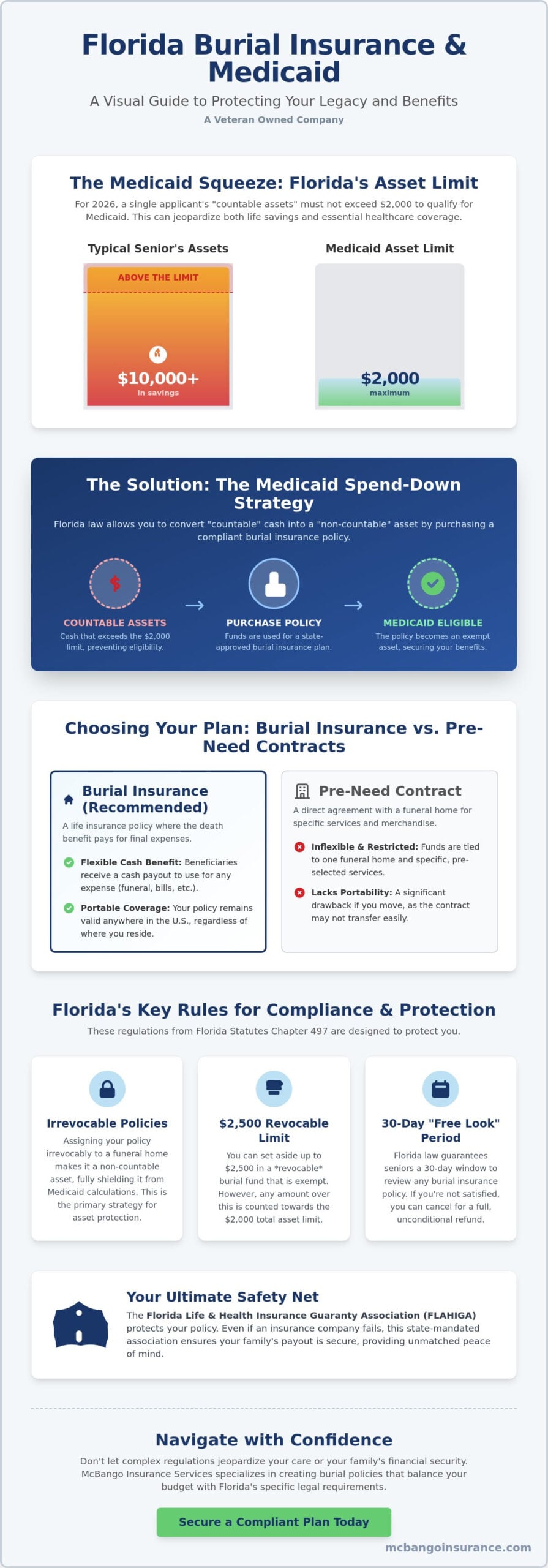
It’s easy to confuse burial insurance with pre-need funeral contracts, but the legal differences are significant. Burial insurance, often categorized as final expense life insurance, pays a cash benefit directly to your beneficiaries. They can use these funds for any urgent need. A pre-need contract is a direct agreement with a specific funeral home for specific services. While Florida law allows a 30-day window to cancel these contracts for a full refund, they often lack portability. If you move away from Florida, a pre-need contract might not follow you, whereas a burial insurance policy remains valid regardless of where you reside.
Licensing Requirements for Florida Brokers
State regulations require anyone selling burial-related insurance to hold a valid Florida Life & Health license. This ensures that your advisor has met the state’s educational and ethical benchmarks. These licensing rules are a protective measure, designed to ensure that the advice you receive is both professional and compliant with current statutes. At McBango Insurance Services, we take this responsibility seriously. As independent brokers, we navigate these complex requirements to find a bespoke arrangement that fits your specific context. We prioritize your well-being over generic solutions, helping you secure a policy that meets Florida’s strict regulatory standards.
Florida Medicaid and Burial Insurance: The Spend-Down Rules
Medicaid eligibility in Florida is a precise science. If your countable assets exceed $2,000 as a single applicant in 2026, you face a significant hurdle. This is where the concept of a “spend-down” becomes vital. By purchasing burial insurance, you can convert countable cash into an exempt asset. This strategy isn’t about spending money needlessly; it’s about securing your future care while protecting your family’s financial peace of mind. Under Florida Statutes Chapter 497, specific rules dictate how these funds are treated during the Medicaid application process.
The $2,500 Revocable Burial Fund
A revocable burial fund is money you set aside for final expenses but still legally control. You can change your mind or access these funds for other emergencies. However, the Florida Economic Self-Sufficiency (ESS) Policy Manual is very strict about how this works. You must keep this money in a dedicated, non-commingled account. If the balance stays at or below $2,500, Medicaid ignores it. If it grows to $2,501, the entire amount could suddenly become a “countable asset,” potentially disqualifying you from benefits. It’s a delicate balance that requires steady oversight.
Irrevocable Assignment of Benefits
For those who need to shield larger amounts of money, an irrevocable assignment is the preferred solution. Unlike the revocable fund, an irrevocable policy cannot be cashed out or canceled. You are legally assigning the death benefit to a funeral provider to cover specific costs. Because you no longer have “access” to the cash value, Florida law treats the entire policy as an exempt asset, regardless of its size. This is a powerful way to meet Medicaid requirements while ensuring a dignified farewell.
Transitioning a standard final expense life insurance policy into an irrevocable trust is a specialized process. It requires a deep understanding of Florida state regulations on burial insurance to ensure the paperwork satisfies state auditors. We often help families navigate this transition to ensure their coverage is “Medicaid-proof” before they submit their application. If you aren’t sure if your current assets put your eligibility at risk, you can use a life insurance needs calculator to see how a new policy might fit into your financial plan. This methodical approach to asset protection helps alleviate the anxiety of losing your health care coverage. By following the state’s structured spend-down rules, you turn a potential vulnerability into a protective measure for your estate.
Revocable vs. Irrevocable Policies: Which Does Florida Law Favor?
Florida law doesn’t strictly favor one policy type over the other; instead, it provides a legal framework where each serves a distinct financial purpose. Choosing between a revocable and an irrevocable arrangement often comes down to your immediate need for flexibility versus your long-term goal of asset protection. Florida state regulations on burial insurance ensure that regardless of the path you choose, you have a guaranteed safety net. One of the most significant protections is the mandatory 30-day “free-look” period for seniors age 65 and older. This period allows you to review your policy thoroughly and return it for a full refund if it doesn’t meet your expectations. This requirement prevents seniors from being pressured into a financial commitment that doesn’t fit their specific context.
There is also a critical legal distinction between locking in a specific funeral home and securing a cash death benefit. While a pre-need contract with a local mortuary might seem convenient, it can lack the portability that many families require. If you move out of state or if the funeral home closes, your family could face a complex legal hurdle to recover those funds. In contrast, a life insurance policy provides a liquid death benefit that your beneficiaries can use at any provider. State law also includes measures to protect you from predatory irrevocable contracts, ensuring that any assignment of benefits is transparent and legally sound.
The Flexibility of Revocable Burial Insurance
A revocable policy allows you to maintain total control over your assets during your lifetime. You have the right to change your beneficiaries, adjust your coverage levels, or even cancel the policy for its cash value if your financial situation changes. This is often the preferred choice for Jensen Beach families who value financial agility and don’t currently face Medicaid eligibility concerns. The primary vulnerability is the state’s asset limit. Because you can access the cash value of a revocable policy, the state considers it a countable asset. If the value of your policy pushes your total assets over the $2,000 threshold, it could jeopardize your eligibility for state-funded care.
The Security of Irrevocable Assignments
If you need to qualify for Medicaid while preserving your legacy, an irrevocable assignment is the most dependable tool available. Once you assign a policy irrevocably, you relinquish the right to cancel it for cash. This loss of flexibility is the trade-off for absolute security. Florida law specifically protects these funds from being seized by creditors, ensuring the money is available exactly when your family needs it most. By selecting final expense life insurance and making it irrevocable, you create a bespoke safeguard for your estate. This legal structure prevents the policy from being counted against your Medicaid asset limits, offering a proactive way to secure your future care and your family’s peace of mind.
Consumer Protections: The Florida Life & Health Insurance Guaranty Association
The fear that an insurance company might fail is a valid concern for anyone planning their legacy. You want to know that the money you set aside today will be there for your family tomorrow. Fortunately, Florida state regulations on burial insurance include robust safeguards to protect policyholders from carrier insolvency. In the rare event that an insurance company can no longer meet its financial obligations, the state provides a specialized safety net to ensure your benefits are paid. This system is designed to offer a steady hand in an unpredictable world, giving you the peace of mind that your investment is secure.
Under Florida law, the Florida Life & Health Insurance Guaranty Association (FLHIGA) serves as a protective barrier for consumers. As of 2026, FLHIGA provides up to $250,000 in coverage for life insurance death benefits per covered life, per carrier. This means that even if your provider faces financial distress, your burial insurance policy remains backed by a state-mandated association. These regulations represent a proactive commitment to senior welfare, ensuring that the promises made by insurance companies are kept, regardless of market fluctuations. It’s a structured solution that addresses one of the most significant anxieties associated with risk management.
How FLHIGA Protects Florida Policyholders
Every insurance company licensed to sell policies in the state must participate in this association. It’s a mandatory requirement that functions as a collective insurance policy for the insurers themselves. FLHIGA is the ‘FDIC for insurance’ in Florida. Before you commit to a policy, it’s essential to verify that your carrier is a member in good standing. This verification process is a simple yet powerful way to safeguard your individualized plan. We handle this due diligence for you, ensuring that every recommendation we make is backed by the stability of the state’s guaranty system.
Identifying Stable Carriers in the Treasure Coast
While the state provides a safety net, the first line of defense is choosing a financially dependable carrier. We look closely at A.M. Best and Weiss ratings to evaluate the long-term health of burial insurance providers. These independent ratings offer a transparent view of a company’s ability to pay claims decades into the future. Working with an independent broker is essential because it allows you to avoid high-risk providers that might offer lower premiums but lack financial depth. Our role is to act as a specialized intermediary, translating these complex financial metrics into understandable benefits for families in Jensen Beach and across the Treasure Coast.
Planning for a stable future starts with understanding your specific requirements. You can use our life insurance needs calculator to determine the right amount of coverage for your situation. Once you know your needs, we can match you with a carrier that meets both your budget and the rigorous standards of Florida state regulations on burial insurance. If you’re ready to secure a policy that is backed by both state protection and financial strength, contact us today for a personalized consultation.
Navigating Florida Burial Regulations with McBango Insurance
Understanding Florida state regulations on burial insurance doesn’t have to be a solitary burden. We act as your dedicated partner, translating dense legal statutes into a clear, actionable plan. Our team at McBango Insurance Services, LLC specializes in the nuances of the 2026 Medicaid asset limits and the specific licensing requirements of Chapter 497. By serving as independent brokers, we offer a broader view of the market than a single carrier could provide. This independence allows us to prioritize your specific needs over a corporate sales quota. We believe that a steady hand in an unpredictable world is the key to lasting security.
Bespoke Final Expense Planning
We reject the “one-size-fits-all” approach because your financial legacy is unique. A generic burial policy might cover immediate costs, but it may fail to align with your broader estate planning goals or Medicaid eligibility requirements. We coordinate every detail to ensure your policy is a protective measure rather than a liability. For a deeper look at local planning, read our sibling article on Final Expense Insurance in Florida: The 2026 Senior’s Guide. This level of customization is essential for residents in Jensen Beach and throughout the Treasure Coast who want to secure their family’s future with confidence. We translate complex policies into understandable benefits, ensuring you know exactly how your coverage works.
Your Next Steps for Secure Coverage
Your path to peace of mind is a methodical yet simple process. When you meet with a McBango broker, we recommend bringing a few key items to help us build your individualized plan:
- A summary of your current assets to ensure Medicaid compliance.
- Information on any existing life insurance coverage you hold.
- A list of your specific wishes for final arrangements.
- The names and contact details of your primary beneficiaries.
Our application process is designed for ease, removing the technical friction that often discourages seniors from completing their planning. We handle the heavy lifting of ensuring compliance with Florida state regulations on burial insurance, so you can focus on what matters most. Our goal is to move beyond mere transactions to build a long-term relationship based on trust. We simplify complex procedures to make your life easier and more secure. A protected future is within reach, and it starts with a single, supportive conversation. Contact McBango Insurance Services today for a compliant burial insurance review and take the first step toward true peace of mind.
Securing Your Legacy with Confidence and Compliance
You now possess the essential tools to navigate the intersection of Medicaid spend-down rules and final expense planning. By understanding how Florida state regulations on burial insurance shield your assets, you can ensure that your policy remains an exempt resource while providing for your family’s future. The state’s legal framework, from the 30-day free-look period to the robust protections of FLHIGA, is designed to offer a steady hand in an unpredictable world. These safeguards allow you to plan with clarity, knowing your investment is both legally protected and financially secure.
At McBango Insurance Services, we specialize in Florida senior final expense planning. Our independent broker expertise gives you direct access to top-rated Florida carriers, ensuring your plan is stable and bespoke to your specific financial context. We simplify the complex statutes so you can focus on what truly matters. Protect your legacy with Florida-compliant burial insurance from McBango Insurance Services. Taking this proactive step today removes the weight of uncertainty from your shoulders. You deserve the peace of mind that comes with a well-structured and legally sound plan.
Frequently Asked Questions
Is burial insurance considered an asset for Medicaid in Florida?
Burial insurance is an exempt asset for Medicaid in Florida if it’s structured as an irrevocable contract or a revocable fund under $2,500. If you hold a revocable policy with a cash value exceeding that limit, the state counts the entire amount toward your $2,000 asset threshold. We help you navigate Florida state regulations on burial insurance to ensure your policy protects your eligibility rather than jeopardizing it.
How much money can I legally set aside for burial in Florida?
You can set aside up to $2,500 in a revocable burial fund, but there is no limit on the amount for an irrevocable pre-need burial contract. Florida law allows you to prepay for a wide range of services, including the casket, vault, and professional services, without these funds counting against your assets. This provides a reliable way to spend down excess cash while securing a dignified service.
What is the difference between a revocable and irrevocable burial trust in FL?
The primary difference lies in your ability to access the funds during your lifetime. A revocable trust allows you to cancel the agreement or change the beneficiary, but it remains a countable asset for Medicaid if it exceeds $2,500. An irrevocable trust is a permanent arrangement that you cannot cash out. Because the funds are no longer accessible to you, the state treats them as an exempt asset.
Does Florida law require a funeral home to be the beneficiary of burial insurance?
No, Florida law does not require you to name a funeral home as your beneficiary. When you purchase burial insurance, which is a form of life insurance, you have the right to name any individual or entity. However, if you are using the policy for Medicaid spend-down purposes, you may need to irrevocably assign the benefits to a funeral provider to meet the state’s exemption requirements.
Can I transfer my Florida burial insurance policy to another state?
Yes, burial insurance policies are generally portable because they are life insurance contracts. Unlike a pre-need contract tied to a specific local funeral home, a life insurance death benefit follows you to any state. If you move away from the Treasure Coast, your beneficiaries can use the payout to cover expenses at a provider in your new location. This flexibility is a key advantage of insurance-based planning.
What happens to my burial insurance if I enter a Florida nursing home?
If you enter a nursing home, your burial insurance stays in place as long as the premiums are paid. If the policy is irrevocable, it won’t affect your Medicaid eligibility for care. It remains a dedicated fund that your family can access immediately upon your passing. This ensures your final wishes are honored without placing a sudden financial burden on your loved ones during a transition to care.
Are there age limits for burial insurance under Florida regulations?
Florida state regulations don’t set a maximum age for purchasing burial insurance, but individual insurance carriers do. Most providers offer coverage to seniors up to age 85, though some specialized products are available for those slightly older. The state focuses more on ensuring that the terms of the policy are clearly disclosed to you during the mandatory 30-day free-look period for seniors.
How do I verify if a burial insurance company is licensed in Florida?
You can verify a carrier’s status through the Florida Department of Financial Services (DFS) website. Every company selling policies under Florida state regulations on burial insurance must be licensed and in good standing. We recommend checking the Licensee Search tool or working with an independent broker who performs this due diligence for you. This verification ensures your policy is backed by a legitimate, state-regulated entity.