If you reach age 70 and your policy expires without ever being used, have you actually wasted two decades of premiums? It’s a question that keeps many people up at night as they cross the threshold into a new decade of life. You’ve likely noticed that costs are rising, and the fear of outliving a policy only to be left with nothing can feel like a significant financial risk. You’re likely asking: is term life insurance worth it in your 50s, or are you simply throwing money at a safety net that’s about to vanish?
We understand that this stage of life requires a steady hand and a clear strategy. While it’s true that premiums for a 50-year-old man can average around $35.45 a month for a $250,000 policy, these costs often double from what you would have paid in your mid-40s. This guide will help you evaluate the real value of your coverage and determine if term life remains the most cost-effective way to protect your family’s future. We’ll explore how to bridge the gap between your peak earning years and a secure retirement, ensuring you have tailored protection that offers true peace of mind.
Key Takeaways
- Learn why your 50s are a critical decade for re-evaluating financial risks, including remaining mortgage balances and the unique pressures of the “sandwich generation.”
- Discover how to determine if is term life insurance worth it in your 50s by aligning policy lengths with your specific timeline for retirement and debt payoff.
- Use a clear two-step framework to calculate “hard liabilities” and “soft needs,” ensuring you aren’t overpaying for coverage you don’t require.
- Understand the strategic shift between using term life for temporary income replacement and whole life for permanent estate or final expense protection.
- See how tailored protection strategies can simplify the process for Florida residents, specifically addressing the needs of families in Jensen Beach and the Treasure Coast.
Is Term Life Insurance Still Worth the Cost in Your 50s?
Entering your 50s often brings a shift in perspective. You’ve likely spent decades building a career and a home, yet the financial finish line isn’t quite here. Determining is term life insurance worth it in your 50s requires looking beyond the monthly bill to the specific risks you still carry. At this age, you aren’t just buying a policy; you’re securing a bridge. This bridge covers the gap between your current liabilities and the day your retirement accounts are fully funded.
To understand the basic mechanics of these policies, it helps to review What is Term Life Insurance? and how it differs from permanent options. Essentially, you’re paying for pure protection during a set window of time. While it’s true that premiums increase as you age, the stakes are often higher now than they were in your 30s. You likely have a higher income to replace and a family that has grown accustomed to a specific standard of living.
To better understand how this fits into your overall financial plan, watch this helpful video:
The Value of “Pure Protection” in Your 50s
For high-earning professionals, term life remains the most efficient tool for managing large scale risks. It offers the highest possible death benefit for every dollar spent on premiums. This allows you to protect a $500,000 mortgage or a $1 million income stream without the heavy costs associated with cash-value policies. The psychological peace of mind that comes from knowing your spouse can stay in your family home is often worth far more than the monthly cost.
Many people follow the “buy term and invest the difference” mantra earlier in life. However, as you approach 55, the math begins to change. With a shorter runway until retirement, you have less time to recover from market volatility. Having a term life insurance policy provides a guaranteed safety net that doesn’t fluctuate with the stock market. It ensures that if the unthinkable happens, your family isn’t forced to liquidate retirement assets prematurely during a market downturn.
Common Misconceptions About Age and Eligibility
A common myth is that coverage becomes unaffordable the moment you blow out 50 candles. In reality, 2026 underwriting standards have become much more favorable for healthy seniors. Many carriers now use simplified underwriting that focuses on your actual health data rather than just your birth year. This allows active 50-year-olds to secure competitive rates that were previously reserved for much younger applicants.
Ultimately, the worth of a policy is the ratio of your monthly premium to the total financial risk your family would face without your income. If you still have significant “hard liabilities,” the answer to whether is term life insurance worth it in your 50s is often a resounding yes. You can use our life insurance needs calculator to see exactly how these numbers stack up for your specific situation.
Evaluating the Financial Risks of Your 50s
Your 50s often represent your peak earning years, but they also bring a unique set of financial pressures. Many people in this age bracket find themselves part of the “sandwich generation,” simultaneously supporting adult children and providing care for aging parents. This dual responsibility creates a fragile financial balance; if your income were to disappear, the ripple effect would impact two generations at once. When you analyze if is term life insurance worth it in your 50s, you’re really looking at the cost of leaving these risks unmanaged. Assessing life insurance for people over 50 becomes a matter of protecting those who depend on your stability.
Mortgage protection is another critical factor. While previous generations may have entered their 50s with a nearly paid-off home, modern trends show many 50-year-olds still owe significant balances. Whether it’s a 30-year mortgage started later in life or a recent refinance, your home remains a major liability. A tailored term policy ensures your spouse can remain in the home without the burden of a monthly payment they can’t afford alone. The “gap years” before Social Security eligibility also present a risk. If a spouse passes away at 54, the survivor may have to wait nearly a decade to access survivor benefits. Term insurance acts as a strategic bridge during these years. You can use our life insurance needs calculator to see exactly how much coverage is required to span that time.
Debt Management and Legacy Protection
Protecting your family’s future often involves managing debts you’ve taken on for others. Many parents co-sign student loans or Parent PLUS loans for their children. Unlike some federal loans, private co-signed debt doesn’t always vanish upon the death of the borrower or the co-signer. In Florida’s competitive real estate market, ensuring your estate has enough liquidity to cover these debts is essential. Unexpected medical expenses can also drain an estate quickly, leaving your heirs with liabilities instead of a legacy. This is why many families choose to secure their plans now rather than waiting for an emergency.
Business Ownership and Key Person Risks
If you own a business, your 50s are likely the final decade before you begin planning your exit. During this time, your role as a “key person” is at its most valuable. A term policy can fund a buy-sell agreement, allowing your partners to buy out your shares and provide your family with fair market value if you pass away unexpectedly. For business owners seeking more permanent options, Universal Life Insurance offers a flexible alternative that can adapt to changing business needs. Getting a clear picture of your current risks is the first step toward security. If you aren’t sure where you stand, speaking with a specialist can help you design a plan that fits your life perfectly.
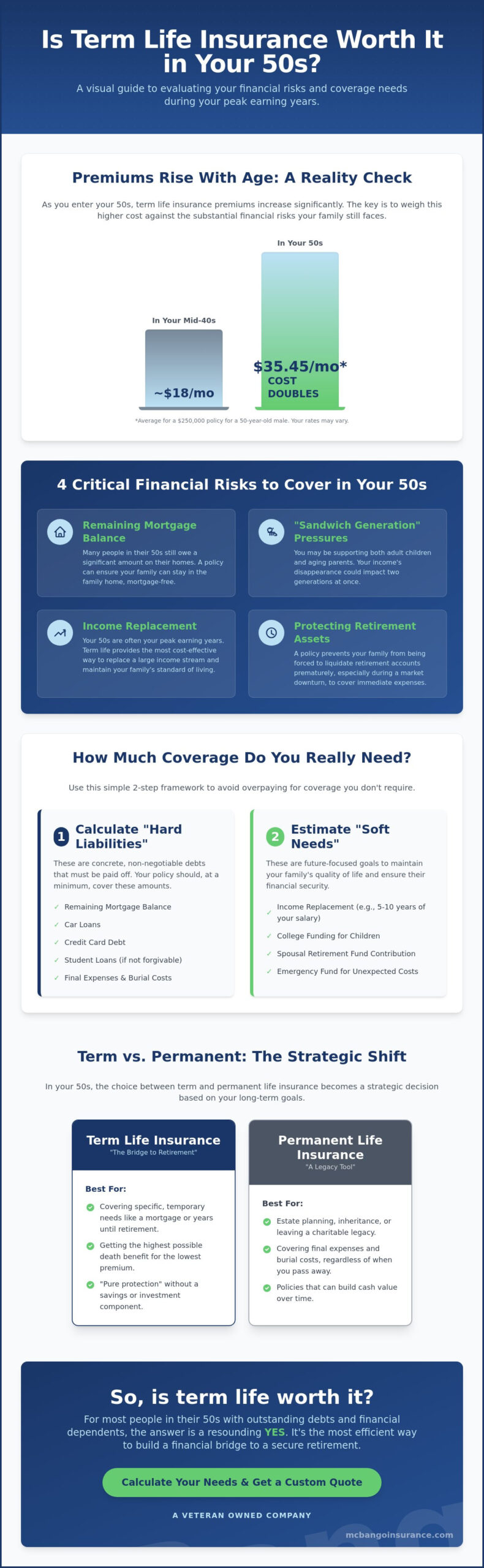
Term vs. Permanent Life Insurance: Strategic Choices for Seniors
Choosing between term and permanent coverage often feels like a tug-of-law between budget and longevity. In your 50s, the decision hinges on whether your financial needs are temporary or lifelong. For many, is term life insurance worth it in your 50s because it offers a high death benefit during the years you still carry a mortgage or have children in college. However, as you approach retirement, the risk of outliving a term policy becomes a valid concern. The 2026 insurance market has remained competitive due to higher interest rates, which allows companies to offer more stable pricing on both product types.
A strategic “hybrid approach” is becoming a popular solution for modern seniors. This involves maintaining a larger Term Life Insurance policy to cover major debts while layering a smaller whole life policy for permanent needs. For example, a 50-year-old man might pay around $35.45 per month for a 20-year, $250,000 term policy to protect his remaining working years. Simultaneously, he might secure a whole life policy to ensure funds are available for estate taxes or final expenses regardless of when he passes away. This tailored arrangement provides the security of a large payout now and the reliability of permanent coverage later.
When to Choose Term Life Insurance
Term life is the ideal tool for covering defined financial windows. If you have 12 years left on a mortgage or want to ensure your grandchildren’s tuition is secure, a 15-year term policy offers a functional, low-cost solution. It’s particularly effective for those who plan to be “self-insured” by age 70. If your retirement accounts and home equity will be sufficient to provide for your spouse in two decades, paying for permanent insurance might not be the most efficient use of your capital. You’re simply buying time until your assets can stand on their own.
The Transition to Final Expense Planning
Relying solely on term insurance can leave a gap in your end-of-life planning. If you outlive your term, your family may face significant burial costs without a dedicated benefit. Integrating Final Expense Life Insurance into your strategy during your 50s ensures these costs are locked in at a lower rate. These policies are designed to be simple and secure, providing immediate funds for your loved ones. For a deeper look at local options, read our Final Expense Insurance in Florida guide. This specialized focus helps Jensen Beach and Treasure Coast families avoid the stress of unexpected end-of-life liabilities.
How to Calculate Your Coverage Needs and ROI
Determining the right amount of coverage requires a methodical look at your current balance sheet. You shouldn’t guess at a number when your family’s stability is on the line. To decide if is term life insurance worth it in your 50s, you can follow a simple four-step process to quantify your actual risk. This transparency helps you avoid overpaying for coverage you don’t need while ensuring no gaps remain in your safety net.
- Step 1: Total your “Hard Liabilities.” List every debt that would fall on your survivors. This includes your remaining mortgage balance, co-signed loans, and anticipated final expenses.
- Step 2: Calculate “Soft Needs.” Estimate the income replacement required for your spouse to reach retirement comfortably. Factor in any remaining education funds for children or grandchildren.
- Step 3: Subtract Liquid Assets. Deduct your current savings, 401k balances, and existing home equity from your total needs. Insurance only needs to cover the remaining deficit.
- Step 4: Factor in 2026 Florida Inflation. Costs for housing and services in areas like Jensen Beach have shifted significantly. Your coverage must account for the local cost of living increases expected over the next decade.
If the math reveals a gap, you can use our life insurance needs calculator to refine these numbers. This tool helps you visualize how a specific policy amount translates into long-term security for your loved ones.
The “Worth It” Math: Premium vs. Probability
When you evaluate a policy, you’re looking at the actuarial “Value of Risk.” For a 50-year-old woman, a 10-year term policy for $1 million might cost approximately $73.48 per month. You should view your premium as a small fractional cost of the total benefit you’re securing. By paying less than $900 a year, you’re effectively offloading a $1 million financial risk to the insurance provider. This trade-off is particularly valuable in your late 50s, as the probability of health changes increases while your earning years decrease.
Health Profiles and Their Impact on Value
Your health status is the primary driver of your 2026 premium rates. Many people assume that minor issues like controlled hypertension or high cholesterol will make coverage unaffordable. However, modern underwriting is often more lenient if these conditions are well-managed with medication. For those who want to avoid a visit from a technician, “No Exam” policies have become an excellent value. These policies use data analysis to provide a secure approval quickly, often within minutes. Working with an independent broker is essential here; they can shop multiple carriers to find the one that offers the best rate for your specific health profile. To see how these factors affect your personal rate, you can request a tailored term life quote today.
Customizing Your Life Insurance Strategy in Florida
Florida residents often deal with unique estate challenges, especially with the state’s specific homestead laws and the rising cost of final expenses. When you evaluate is term life insurance worth it in your 50s, you must consider the local economy. In 2026, the cost of living in the Sunshine State continues to fluctuate, meaning a policy that seemed sufficient five years ago might now leave your family short. We help you navigate these regional factors to ensure your coverage is truly comprehensive and accounts for the specific financial environment of our state.
Not every national insurance company understands the nuances of the Florida market. Some carriers may have different pricing structures for residents here or specific underwriting guidelines for coastal risks. We leverage our local expertise to find “Florida-friendly” carriers that offer the best value for seniors. This specialized knowledge ensures you don’t overpay for a generic policy that fails to account for your geographic context. We act as a steady hand, translating complex state regulations into understandable benefits for your family.
Local Expertise in Jensen Beach
Jensen Beach and the wider Treasure Coast have unique demographic profiles. Many families here are managing multi-generational estates or looking to protect property that has seen significant appreciation. Our team at McBango Insurance Services lives and works in this community. We understand the specific financial pressures you face every day. For a deeper look at how we tailor plans for our neighbors, explore our guide on Life Insurance in Jensen Beach. We focus on creating security for the people who make this region home.
Your Path to a Secure 2026
Securing your family’s future shouldn’t be a complex or stressful ordeal. We use a direct problem-solution framework to help you identify vulnerabilities and implement protective measures. If you’re worried about rising premiums or outliving your coverage, we’ll show you how a customized policy can be structured as a strategic bridge to your retirement. We don’t believe in one-size-fits-all products. Instead, we offer bespoke arrangements designed for your specific life stage and goals.
Peace of mind is the ultimate goal. Whether you need to cover a final mortgage or ensure your surviving spouse is cared for, we provide the reliable service you deserve. Take the first step toward a more secure retirement today. Contact McBango Insurance Services for a tailored term life review and let us help you build a plan you can trust for years to come.
Securing Your Legacy with Confidence
You’ve explored how term life acts as a vital bridge between your working years and a fully funded retirement. By calculating your hard liabilities and accounting for Florida’s unique economic landscape, you can move past the uncertainty of whether is term life insurance worth it in your 50s. It’s about replacing anxiety with a structured plan that protects your spouse and children from the weight of unexpected debt. This strategic re-evaluation ensures your coverage evolves alongside your life.
At McBango Insurance, we serve as your steady hand in this process. Our independent brokers shop over 50 top-rated carriers to find the specific coverage that fits your life in Jensen Beach or the Treasure Coast. We provide empathetic, expert guidance to ensure your final expense and life planning needs are met with precision. Don’t leave your family’s security to chance. Request a Tailored Term Life Quote from McBango Insurance today and take control of your financial future. You’ve worked hard to build this life; we’re here to help you protect it.
Frequently Asked Questions
Is it too late to get term life insurance at age 55?
No, it is not too late to secure coverage. Many insurance companies, including Banner Life and Fidelity Life, actively market products to individuals up to age 75. At 55, you can still obtain 10, 15, or 20-year terms to protect your family during your final working years. It’s a proactive way to ensure your mortgage and other debts are covered as you approach retirement.
How much does a $500,000 term life policy cost for a 50-year-old in 2026?
A $500,000 policy for a 50-year-old man typically starts around $70 per month. This is based on 2026 sample rates where a $250,000, 20-year term policy for a man of the same age is approximately $35.45. For a 50-year-old woman, the cost for that same $250,000 coverage is roughly $31.97. Your final premium will depend on your specific health class and the term length you select.
Can I convert my term life policy to whole life later?
Most term policies include a conversion rider that allows you to switch to whole life insurance without a new medical exam. This is a secure way to maintain coverage if your health changes or if you decide you need a permanent benefit for estate planning. You usually must exercise this option before the term expires or before you reach a certain age, such as 65 or 70.
What happens if I outlive my term life insurance policy?
If you outlive the term, your coverage ends and the insurance company does not pay a death benefit. To prevent being left without protection, many people evaluate if is term life insurance worth it in your 50s by pairing it with a small permanent policy. This ensures you have a reliable benefit for burial costs even after your larger term policy for income replacement has served its purpose.
Is term life insurance better than whole life for seniors in Florida?
Neither policy is universally better because the right choice depends on your financial goals. Term life is the most cost-effective way to cover temporary liabilities like a 15-year mortgage. Whole life is a permanent solution designed for final expenses and estate taxes. We often suggest a tailored approach that combines both to provide comprehensive protection for Treasure Coast families.
Do I need a medical exam for life insurance in my 50s?
You don’t always need a physical exam to get approved in 2026. Many carriers now use simplified underwriting processes that rely on your health questionnaire and data analysis rather than a medical visit. This makes the application process much faster and more convenient. However, a traditional medical exam might still be the best path if you’re in excellent health and want the lowest possible premiums.
How does smoking or health history affect my term life rates at 50?
Smoking can cause your premiums to double or even triple compared to non-smokers. Your health history is also a major factor, as rates nearly double from the mid-40s to the mid-50s. Because premiums increase so significantly with age, applying while you’re relatively healthy is the most effective way to lock in a secure and affordable rate for the next two decades.
Can I have multiple life insurance policies in my 50s?
Yes, you can hold multiple policies to address different financial needs. This strategy, often called laddering, allows you to have a large term policy for your peak earning years and a separate whole life policy for permanent end-of-life costs. Having multiple policies ensures that is term life insurance worth it in your 50s by allowing you to customize your protection as your liabilities decrease over time.