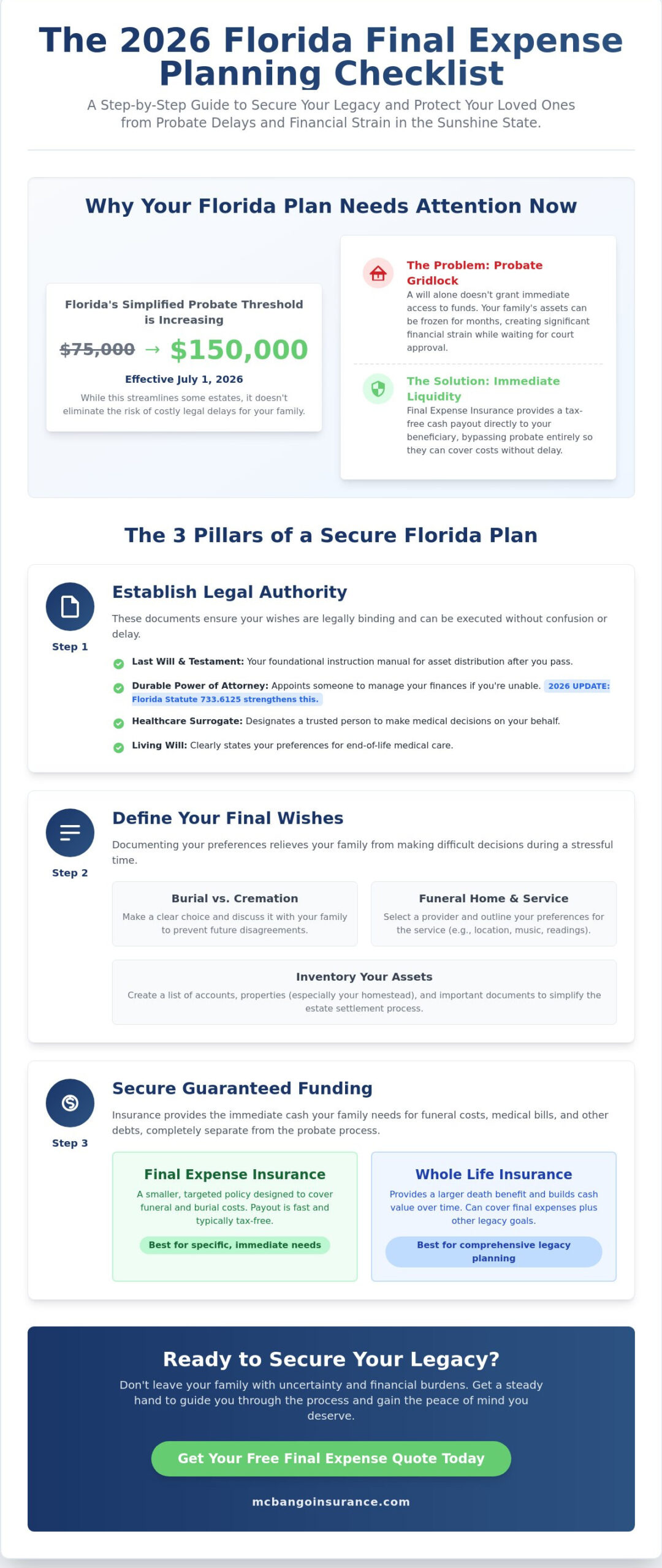
Did you know that as of July 1, 2026, Florida’s threshold for simplified probate is scheduled to increase to $150,000? While this legislative change aims to streamline estate distribution, many families still feel anxious about the rising costs of Florida funerals and the potential for legal delays. You’ve worked hard to build your life in the Sunshine State, and it’s natural to want a steady hand guiding your family through these complex transitions. That’s why a comprehensive final expense planning checklist for Florida residents is an essential tool for securing your legacy.
This guide provides a clear, step-by-step roadmap to protect your loved ones from unexpected financial burdens and probate confusion. We’ll explore the three pillars of an effective plan: establishing legal authority under the newest 2026 statutes, defining your logistical wishes, and securing guaranteed funding through personalized options like burial insurance or whole life insurance. You’ll learn how to simplify the process, ensuring your family has the peace of mind they deserve during a difficult time.
Key Takeaways
- Discover why Florida probate statutes mean a standard will might not be enough to protect your family from asset distribution delays.
- Use our comprehensive final expense planning checklist for Florida residents to inventory your assets and safeguard your homestead.
- Evaluate the practical differences between burial and cremation in the Sunshine State so you can document your wishes with clarity.
- Explore how specialized insurance products like final expense or whole life policies provide the immediate funds your loved ones will need.
- Gain a steady hand in your planning process by learning how to coordinate legal authority with financial security for a seamless legacy.
Why Final Expense Planning is Unique for Florida Residents
Final expense planning in the Sunshine State involves more than just selecting a service. It’s a strategic alignment of your end-of-life wishes with specific Florida statutes to ensure your family isn’t left with a complex legal puzzle. Utilizing a final expense planning checklist for Florida residents helps you account for unique state factors like homestead protections and the specific ways Florida courts handle small estates. This process transforms a difficult topic into a clear, manageable plan that provides your loved ones with a steady hand during their time of grief.
In 2026, economic trends continue to push the cost of labor and materials higher in the funeral industry. Florida’s high concentration of retirees means local providers often face high demand, which can lead to limited availability and rising service fees. Planning ahead allows you to lock in your intentions and prepare for these shifting costs before they become a crisis for your survivors. Proactive preparation is the most effective way to ensure your legacy remains a gift rather than a burden.
To better understand why this planning is so vital in our state, watch this helpful video:
Understanding the Florida Probate Process
Probate is the court-supervised process of identifying and distributing a deceased person’s assets. In Florida, this can be a slow and public ordeal. While a will provides instructions, it doesn’t grant immediate access to funds. Effective July 1, 2026, the threshold for Summary Administration, a faster version of probate, is scheduled to increase to $150,000. Even with this change, your loved ones might wait months for a judge to release assets. This is where final expense insurance plays a vital role. It provides immediate liquidity, allowing your family to pay for urgent needs without waiting for the court’s permission. Many residents prioritize these policies specifically to avoid the financial gridlock that often accompanies probate.
The Financial Burden on Sunshine State Families
Families in areas like the Treasure Coast face a variety of costs ranging from professional service fees to transportation and casket expenses. The federal Funeral Rule protects you by requiring funeral homes to provide itemized price lists, but the total bill can still be overwhelming if you haven’t planned ahead. You must consider the local market’s specific pricing for cemetery plots and cremation services, which often vary significantly by county. Final expense insurance is a tool for immediate cash flow that bridges the gap between your passing and the distribution of your estate. By including insurance in your final expense planning checklist for Florida residents, you ensure your family has the dependable support they need to honor your legacy without financial strain.
The Essential Legal Documents for Your Florida Checklist
A final expense planning checklist for Florida residents must prioritize legal authority to ensure your wishes are followed without delay. Your Last Will and Testament serves as the foundational instruction manual for your estate, but it only takes effect after you pass away. To protect your interests while you’re alive, a Durable Power of Attorney is vital. Effective July 1, 2026, Florida Statute 733.6125 strengthens this document by allowing your representative to seek attorney fees if a bank or institution is uncooperative. This provides a steady hand in managing your affairs when you can’t do so yourself.
Medical decisions require their own set of specific tools. A Healthcare Surrogate Designation allows you to choose a trusted voice for medical decisions if you become incapacitated. You should pair this with a Living Will to define your preferences for end-of-life care under Florida law. If you’re looking for guidance on state-specific regulations, Florida’s Division of Funeral, Cemetery, and Consumer Services offers valuable consumer resources to help you understand your rights. These documents work together to alleviate the anxiety of the unknown, ensuring your preferences are documented and enforceable.
Florida’s unique homestead laws also play a critical role in your planning. While your primary residence is generally protected from creditors, it can still become trapped in probate without the right paperwork. Proactive legal steps ensure this protection extends to your heirs without the interference of a lengthy court process.
Florida-Specific Tools: The Ladybird Deed
The Enhanced Life Estate Deed, commonly known as a Ladybird Deed, is a specialized tool for Florida homeowners. It allows your property to pass automatically to your heirs upon your death while avoiding the probate court entirely. You retain full control over the home during your lifetime, including the right to sell or mortgage it. This arrangement is highly effective when coordinated with your financial plan. Aligning your deed with your insurance beneficiaries prevents legal conflicts and ensures your most valuable asset transitions smoothly to the next generation.
Designating Beneficiaries Correctly
Many residents assume their will dictates where every asset goes. In reality, beneficiary designations on financial accounts usually override what’s written in a will. A common mistake for Florida seniors is failing to update “Pay on Death” (POD) settings on bank accounts after major life changes. While July 1, 2026, marks the date when Florida Statute 655.933 will simplify safe deposit box access for representatives, direct beneficiary naming remains the fastest way to transfer funds. When you secure final expense life insurance, naming your beneficiaries correctly ensures the payout goes directly to the person handling your arrangements. You can calculate your specific needs to determine the right coverage amount, providing your family with the immediate liquidity they need to honor your legacy.
Organizing Your Final Wishes and Funeral Logistics
Organizing your final wishes is a gift of clarity to your family. While legal documents provide the framework, the logistical details determine the day-to-day ease for your survivors. A comprehensive final expense planning checklist for Florida residents should include specific instructions for your service, whether you prefer a traditional burial or cremation. In the Treasure Coast area, choosing a local funeral home or cemetery in advance allows you to compare services and ensure your preferences align with your budget. This proactive step removes the burden of making urgent decisions from your loved ones during their first few days of grief.
Many seniors wonder if they should pre-pay for their funeral. While locking in prices seems attractive, pre-paying directly to a funeral home carries risks if the business closes or if you decide to move out of state. A more secure alternative is pre-planning your logistics and funding them through final expense insurance. This approach keeps you in control of your funds while providing the necessary liquidity for your heirs. For official guidance on consumer protections and industry regulations, you can consult the Florida Department of Financial Services Consumer Help resource.
When organizing these logistics, it’s vital to remember how Florida’s constitutional homestead protection affects your estate. This protection shields your primary residence from most creditors, including funeral homes or medical providers seeking payment for end-of-life costs. Because your home is generally safe from these claims, your family can focus on honoring your wishes without the fear of losing their residence to settle estate debts. This unique Florida benefit provides an additional layer of security for your legacy.
Cremation and Burial Considerations in FL
Florida’s cremation rate remains higher than the national average, driven by the state’s large retiree population and the flexibility it offers families who live in different parts of the country. According to 2026 data, a traditional funeral with burial in Florida typically costs between $7,200 and $13,000. In contrast, cremation with a memorial service ranges from $3,200 to $6,500, while a direct cremation can cost between $1,400 and $2,800. If you choose cremation, be aware of Florida regulations regarding the scattering of remains. While you can scatter ashes on private property with permission, public lands and waterways have specific permitting requirements that you should document in your non-legal “Letter of Instruction.”
The Importance of a Digital Legacy Plan
Your planning shouldn’t stop at physical assets. A digital legacy plan is essential for organizing passwords, social media accounts, and online financial records for your Florida heirs. You should store these details securely, perhaps in an encrypted digital vault or a fireproof safe, alongside your letters of administration. Ensure your personal representative knows how to access this information to prevent the loss of sentimental photos or important account access. A clear plan reduces family conflict more than a large inheritance.
Funding Your Plan: Choosing the Right Insurance Policy
Securing the necessary funds is the final piece of the puzzle. Integrating a funding strategy into your final expense planning checklist for Florida residents ensures that your logistical choices aren’t just wishes, but guaranteed realities. Final expense insurance is specifically designed to cover end-of-life costs, providing a dedicated pool of capital that remains separate from your other investments. This specialization allows your family to settle funeral bills and medical expenses immediately, without dipping into their own savings or waiting for estate assets to clear.
You might worry that your health history will prevent you from obtaining coverage. Many policies offer a “no medical exam” option, which relies on a simplified health questionnaire instead of invasive tests. This approach prioritizes accessibility, making it easier for seniors with managed health conditions to find a policy that fits. To determine exactly how much coverage you need to account for inflation and local service costs, you can use a life insurance needs calculator to find your target amount.
Why Final Expense Insurance is Often the Best Fit
The primary benefit of this coverage is the speed and simplicity of the payout. Cash payouts are typically tax-free for beneficiaries, providing them with the full value of the policy when they need it most. Because the underwriting is simplified, it accommodates common senior health issues that might disqualify you from traditional high-limit life insurance. If you feel overwhelmed by the options, McBango Insurance Services provides local expert guidance to help you select a plan tailored to your Florida lifestyle.
Comparing Term and Universal Life Options
While final expense policies are excellent for immediate needs, other products might better suit your long-term goals. For example, term life insurance often makes sense for younger Florida families who need high coverage amounts for a specific period, such as until a mortgage is paid off. On the other hand, the stability of universal life insurance offers more flexibility for those who want to build cash value over time while maintaining permanent protection. Your choice depends on your specific budget and health profile. If you’re ready to secure your family’s future, explore our final expense options to find the right safeguard for your legacy.
The 2026 Florida Final Expense Planning Checklist
Bringing together legal, logistical, and financial pillars into one cohesive strategy is the only way to ensure your legacy remains secure. A complete final expense planning checklist for Florida residents acts as your personal roadmap, transforming a complex set of tasks into a series of manageable steps. By following this structured approach, you provide your family with a steady hand to guide them through one of life’s most challenging transitions. Use the following steps to build your plan today.
- Step 1: Inventory your assets and debts. Identify all accounts and property, paying special attention to your Florida Homestead. Ensure you understand which assets are protected from creditors and which might be subject to probate.
- Step 2: Secure your four core legal documents. Work with a professional to draft your Will, Durable Power of Attorney, Healthcare Surrogate Designation, and Living Will. With the 2026 increase in the Summary Administration threshold to $150,000, verify if your estate now qualifies for this simplified process.
- Step 3: Calculate your total final expense need. Combine the cost of your chosen service (averaging $7,200 to $13,000 for burials or $3,200 to $6,500 for cremation with a memorial) with any outstanding debts and estimated probate fees. Use a life insurance needs calculator to get an accurate figure.
- Step 4: Shop for a policy with an independent Florida broker. Compare rates for final expense life insurance or whole life options to find a plan that fits your health profile and budget.
- Step 5: Share the plan and store documents safely. Tell your family where your documents are kept. Remember that as of July 1, 2026, Florida Statute 655.933 makes it easier for your representative to access safe deposit boxes, but they still need to know where the keys are located.
Step-by-Step Action Plan
Start with a consultation to identify any existing gaps in your current coverage. When selecting a policy, focus on options that offer “Day 1” coverage for immediate peace of mind, ensuring your family isn’t left waiting for benefits during a waiting period. Life changes quickly in the Sunshine State, so you should review your plan every 3 years or after a major Florida move to keep your beneficiary designations and legal documents current.
Why an Independent Broker is Your Best Checklist Partner
An independent broker serves as a specialized intermediary who works for you, not the insurance company. This allows you to compare multiple carriers through one local agency, ensuring you receive a bespoke arrangement rather than a generic solution. McBango Insurance Services simplifies the complex application process by handling the technical details and translating policy terms into understandable benefits. Professional authority combined with empathetic reassurance makes the entire process easier and more secure for you and your heirs.
Take the Next Step Toward Lasting Security
You’ve seen how 2026 legal updates and rising local costs make proactive preparation more important than ever. By aligning your legal authority with guaranteed funding, you ensure that your final wishes are respected without causing financial strain for your survivors. Completing a final expense planning checklist for Florida residents provides the stability your family needs when they need it most. This process moves beyond simple transactions to create a customized shield for your legacy.
Our team provides the steady hand you need to navigate these choices with ease. We are independent brokers who work for you, not the insurance companies, offering specialized expertise in Florida-specific burial and life insurance. We take pride in delivering empathetic service designed for Treasure Coast seniors, focusing on bespoke arrangements that simplify complex procedures. We’re here to ensure your transition is handled with the dignity and clarity you’ve worked so hard to establish.
Secure your family’s future with a personalized Florida final expense plan today.
You deserve the peace of mind that comes from knowing your affairs are in order and your family is protected by a plan designed specifically for them.
Frequently Asked Questions
How much does a funeral typically cost in Florida in 2026?
In 2026, a traditional funeral with burial in Florida typically costs between $7,200 and $13,000. If you choose cremation with a memorial service, the average price ranges from $3,200 to $6,500. Direct cremation is the most economical path, generally costing between $1,400 and $2,800. These costs depend on your specific county and the service provider you select.
Do I really need a will if I have final expense insurance?
You still need a will because insurance and legal documents serve two different roles in your estate. While insurance provides immediate cash for your funeral, a will provides the legal authority to distribute your physical property and name a personal representative. Including both in your final expense planning checklist for Florida residents ensures that your family has both the money and the instructions they need.
What is a Ladybird deed and why is it popular in Florida?
A Ladybird deed is a specialized legal document that allows your home to transfer automatically to your heirs upon your death without going through probate. It’s popular in Florida because it lets you keep full control of your property while you’re alive, including the right to sell or mortgage it. This tool provides a steady hand in safeguarding your most valuable asset for the next generation.
Can I get final expense insurance in Florida if I have health issues?
Yes, you can obtain coverage even with existing health conditions through simplified underwriting options. Many policies don’t require a medical exam and instead use a basic health questionnaire to determine eligibility. These products are designed specifically for seniors, ensuring that common health issues don’t stand in the way of protecting your family from unexpected costs.
How long does it take for a final expense policy to pay out?
Most final expense policies pay out within 24 to 48 hours after the insurance company receives and verifies the death certificate. This speed is a major advantage over probate assets, which are often frozen for months by the court system. Rapid access to these funds allows your beneficiaries to pay for services and medical bills without using their own savings.
Is my Florida home protected from final expense debts?
Your primary residence is generally protected from most creditors through Florida’s constitutional homestead protection. As long as the home passes to a protected heir, it can’t be seized to settle funeral bills or other estate debts. Understanding this protection is a vital part of a final expense planning checklist for Florida residents as you inventory your assets and debts.
What happens if I die in Florida without an estate plan?
Dying without a plan means Florida’s intestacy laws will dictate how your assets are distributed among your relatives. This process is often slow, expensive, and may not align with your actual wishes for your property or your service. Without a structured plan, your family might face legal hurdles and emotional stress that could have been avoided with simple preparation.