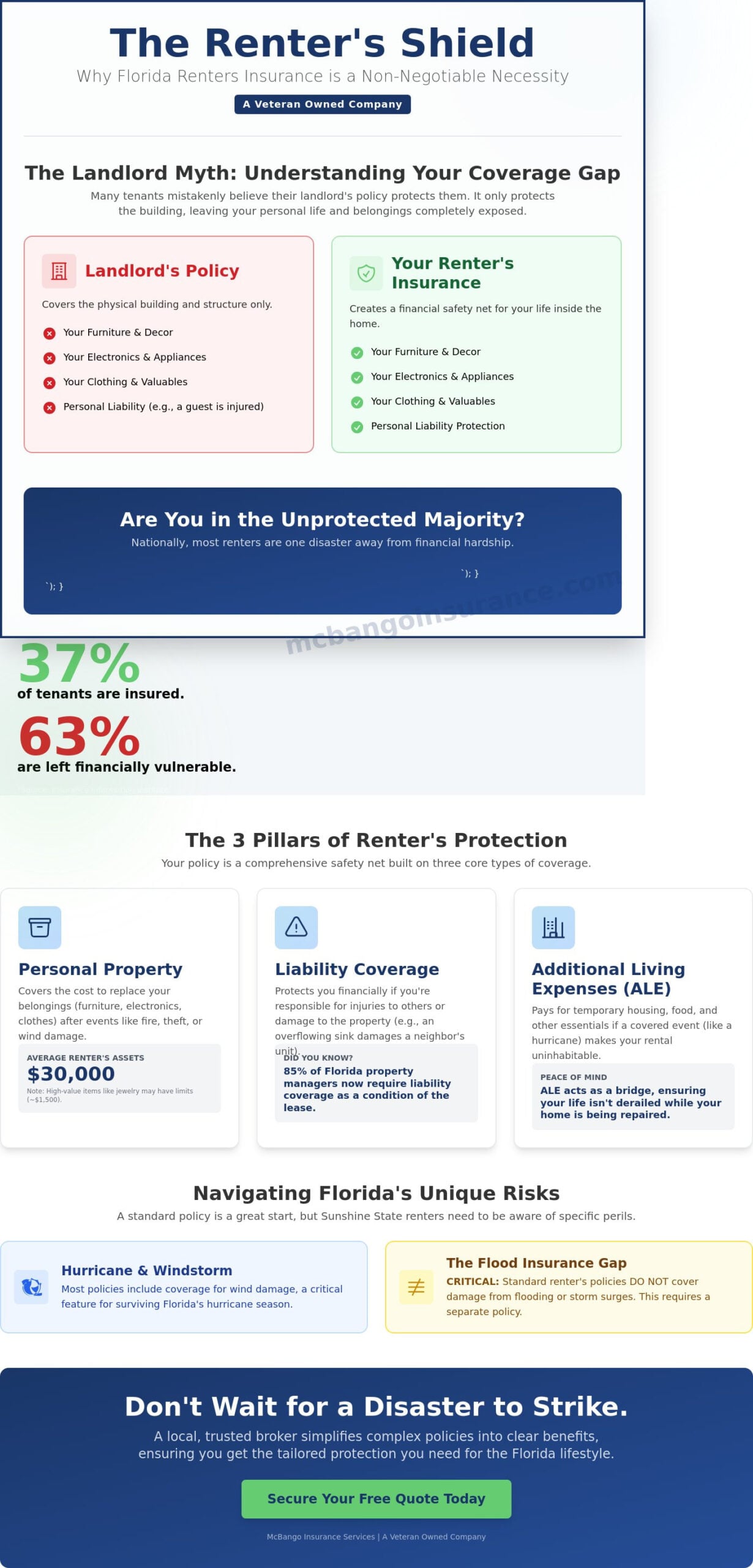
When the 2024 hurricane season brought record-breaking winds to the Treasure Coast, many residents discovered too late that their landlord’s policy only covered the building’s structure, not their personal life inside it. While your property manager protects the walls and roof, your furniture and electronics remain vulnerable unless you have your own renters insurance. According to the Insurance Information Institute, only 37% of tenants across the country currently maintain a policy; this leaves the majority of renters to face the full cost of replacing their belongings after a disaster.
We understand that the rising cost of living in Florida makes every dollar count, and the complexity of policy jargon often feels more like a barrier than a benefit. You deserve to feel secure in your home without worrying about fine print or unexpected liabilities. This guide shows you how to find affordable, tailored protection that fits the unique Sunshine State lifestyle. We’ll break down exactly what your landlord doesn’t cover, explain how to safeguard your assets against hurricane damage, and simplify the process of securing your financial future.
Key Takeaways
- Understand why your landlord’s policy won’t protect your personal assets and how to secure your belongings within a leased residence.
- Discover how Florida renters insurance provides a reliable safety net for your property and liability, ensuring peace of mind in an unpredictable world.
- Learn to navigate Florida-specific risks, including the vital distinction between windstorm provisions and the common flood insurance gap.
- Explore how proximity to the Atlantic coast affects your costs and find the ideal balance between monthly premiums and deductibles.
- Gain the advantage of tailored protection by working with a local broker who simplifies complex policies into clear, comprehensive benefits.
Why Florida Renters Insurance is Essential in 2026
Renters insurance serves as a specialized contract that reimburses you for the loss of personal possessions and defends you against liability claims while living in a leased property. In 2026, this coverage is no longer a luxury for those living on the Treasure Coast; it’s a fundamental component of a responsible financial plan. When Understanding Renters’ Insurance, it helps to view the policy as three distinct pillars: personal property protection, liability coverage, and additional living expenses.
Many tenants fall for the “Landlord Myth,” which is the dangerous assumption that the building owner’s policy covers everyone inside. This isn’t the case. Your landlord’s insurance policy covers the physical structure, but it stops at your front door. If a pipe bursts in your Jensen Beach apartment, the property owner’s policy pays for the drywall and flooring, yet it won’t replace your water-damaged furniture, clothing, or high-end electronics. Without your own policy, you’re left to replace everything out of your own pocket.
To better understand how this protection works, watch this helpful video:
Florida’s unique rental landscape adds another layer of urgency. Residents in coastal areas like Stuart and Fort Pierce face environmental risks that inland states don’t encounter. Data from the 2024 Atlantic hurricane season showed that even minor storm surges can lead to significant interior damage for ground-floor tenants. A small monthly investment in renters insurance ensures that a single storm or localized flood doesn’t erase your hard-earned financial stability.
The Legal Reality for Florida Tenants
Florida Statutes Chapter 83 governs the relationship between tenants and landlords. While the law doesn’t explicitly mandate insurance for all citizens, it grants landlords the right to require it as a condition of the lease. By January 2025, approximately 85% of professional property management firms in Florida made proof of coverage a non-negotiable term for move-in. This requirement protects the landlord from liability, but it also acts as a “security deposit” for your personal net worth. If you’re held responsible for a fire that damages the complex, your liability coverage pays for the repairs instead of a court seizing your personal savings.
The Emotional Value of Tailored Protection
Living in a high-risk weather state often brings a baseline of anxiety during the summer months. Tailored protection alleviates the “what if” scenarios that keep many families awake during tropical storm warnings. By securing a policy, you’re taking a proactive step for your family’s security, ensuring that you’ll have a hotel budget and replacement funds if your home becomes uninhabitable. Renters insurance is a bridge between temporary housing and permanent financial security.
Understanding the 3 Pillars of Florida Renters Coverage
Your Florida lifestyle involves more than just a place to sleep; it includes the gear that makes living on the Treasure Coast enjoyable. Whether you are storing a MacBook for remote work or a specialized surfboard for mornings at the inlet, your renters insurance policy provides the security you need. Most residents view these policies as a simple requirement from a landlord, but they actually function as a comprehensive safety net built on three distinct pillars of protection. We focus on creating a steady hand for our clients, ensuring that every policy is a tailored fit for their specific living situation.
Protecting Your Personal Belongings
Personal property coverage handles the replacement of your items if they are damaged by “named perils” like fire, wind, or theft. According to 2023 industry reports from the Insurance Information Institute, the average renter owns approximately $30,000 worth of personal property. We recommend using digital inventory tools, such as mobile apps that allow you to photograph receipts and serial numbers, to document these assets before a claim occurs. Standard policies often have sub-limits for high-value items, typically capping jewelry or professional sports equipment at $1,500. If your collection exceeds these amounts, we can help you add a scheduled personal property rider to ensure full replacement value.
The Critical Role of Loss of Use in Florida
Loss of Use, also known as Additional Living Expenses (ALE), is essential for anyone living in storm-prone areas like Jensen Beach. If a tropical storm or a kitchen fire makes your apartment uninhabitable, this pillar pays for the increase in your daily living costs. It covers hotel stays, temporary apartment rentals, and even the extra cost of restaurant meals while you are displaced. During the active 2024 hurricane season, many residents realized that having a plan for immediate relocation was the difference between chaos and comfort. At McBango Insurance, we simplify the claims process so you can focus on your family’s safety while we handle the logistics of your temporary housing costs.
Beyond your belongings and relocation, your policy includes liability coverage and medical payments to others. Liability protection guards your savings if you are found legally responsible for someone else’s bodily injury or property damage. For minor incidents, such as a guest tripping over a rug, the medical payments portion handles small bills quickly. This proactive measure often prevents minor accidents from evolving into expensive legal disputes, providing you with genuine peace of mind.
Calculating the Cost of Renters Insurance in Florida
Your monthly premium is a reflection of the specific risks associated with your Treasure Coast residence. Insurance providers evaluate your location with precision, often looking at your ZIP code to determine your proximity to the Atlantic coast. Homes located within five miles of the shoreline typically face higher rates due to increased exposure to wind and storm surges. Finding a balance between your deductible and your premium is the most effective way to manage your monthly budget. A higher deductible reduces your monthly payment, but it requires you to have more savings available if you need to file a claim. At McBango Insurance, we focus on creating a secure plan that protects your assets without overextending your finances.
Factors Influencing Your Florida Quote
The physical characteristics of your rental property play a significant role in determining your final quote. Insurers prioritize structural integrity and safety measures to mitigate potential losses. Consider these primary influencers:
- Construction Material: Buildings constructed with concrete blocks generally earn lower rates than wood-frame structures because they offer superior resistance to fire and high-wind events.
- Building Age: Properties built after the implementation of the 2002 Florida Building Code often qualify for better rates because they meet stricter safety standards.
- Safety Enhancements: You can secure immediate credits by verifying the presence of deadbolts, smoke detectors, and hurricane shutters.
- Local Expertise: A local broker identifies specific regional credits that national platforms often overlook, such as discounts for gated communities or 24-hour security patrols.
ACV vs. Replacement Cost: A Critical Comparison
Choosing the right valuation method determines how much support you receive after a disaster. This choice is often the difference between a partial recovery and a fresh start. We provide tailored advice to help you select the option that offers the most reliable peace of mind.
- Actual Cash Value (ACV): This policy pays out based on the current market value of your items. It subtracts depreciation from the original price, which often leaves a gap between your payout and the cost of buying new goods.
- Replacement Cost Value (RCV): This coverage pays the actual cost to purchase a brand-new version of your lost or damaged items at today’s retail prices.
Replacement Cost is the gold standard for Florida renters wanting full recovery because it ensures you can replace your belongings without dipping into your personal savings. You can also lower your overall expenses by bundling your renters insurance with other Florida insurance products, such as an auto policy, to unlock significant multi-line discounts. This proactive approach simplifies your bill management while strengthening your total protection package.
Florida-Specific Risks: Hurricanes, Floods, and Liability
Living on the Treasure Coast brings unique joys and specific risks. Standard renters insurance policies provide a foundation of protection, but Florida’s environment requires a more nuanced approach to ensure you aren’t left with a massive bill after a storm. You need to understand that a policy in Florida doesn’t always function like one in the Midwest. Tropical humidity, coastal surges, and local legal standards change the math of your coverage.
Navigating Hurricane Season as a Renter
When a tropical system develops in the Atlantic, the clock starts ticking for your coverage. Most insurance carriers implement a binding moratorium once a hurricane watch or warning is issued for our area. This is often called the 72-hour rule. During this window, you cannot start a new policy or increase your coverage limits. You must secure your renters insurance well before the clouds turn gray.
You should also check your declarations page for “named storm” provisions. If a storm receives a name from the National Hurricane Center, your standard flat deductible often switches to a percentage. While a typical deductible might be $500, a named storm deductible is frequently 2% to 10% of your total personal property limit. While protecting your belongings is vital, you should also consider Life Insurance in Jensen Beach for total family protection planning.
The Importance of Liability in the Sunshine State
Florida is known for its active, outdoor lifestyle, but this brings increased liability exposure. If you own a dog, you face strict liability laws. In Florida, owners are often held responsible if their dog bites someone, regardless of the animal’s prior history. Your renters insurance liability coverage is your first line of defense against these costly legal claims.
- Pool Access: Even if you don’t own the pool, you could be liable if a guest slips on a wet surface inside your rental.
- Away-from-Home Coverage: Your liability protection usually follows you. If you accidentally cause a fire at a hotel or injure someone at a park, your policy can help cover the damages.
- Asset Protection: If you have significant savings or investments, a standard $100,000 limit might not be enough. Increasing this to $300,000 or $500,000 is often very affordable and protects your future earnings.
Don’t confuse wind damage with flood damage. Standard policies cover rain that enters through a hole in the roof caused by wind. They do not cover “rising water” from the ground. If the Indian River overflows into your apartment, only a separate flood policy will reimburse you for your ruined furniture and electronics. Bridging this gap is essential for anyone living on the ground floor or near the coast.
Protect your Treasure Coast lifestyle with a policy that understands Florida risks. Contact McBango Insurance today to review your coverage limits.
Securing Tailored Protection with a Local Florida Broker
Florida’s insurance market remains notoriously volatile. In 2025, several carriers adjusted their risk profiles, making it more difficult for tenants to find affordable coverage independently. At McBango Insurance, we simplify these complexities. We act as a steady hand, guiding you through policy jargon to ensure your Treasure Coast home stays protected. Our approach replaces anxiety with a clear, actionable plan tailored specifically to your lifestyle and location.
The Advantage of Independent Advocacy
Choosing an independent broker offers a distinct edge over captive agents who only represent a single national brand. Captive agents are restricted by their company’s specific appetite for risk, which can lead to higher premiums or limited options. We maintain relationships with multiple carriers across the state instead. This diversity allows us to shop for the best rates and coverage limits even when market conditions shift. You aren’t just a policy number in a database. We treat you like a neighbor because we live and work in the same Florida communities.
Understanding your total financial picture is vital for long-term security. We recommend you use our Life Insurance Needs Calculator to evaluate how your current protection aligns with your future goals. This holistic view ensures that every premium dollar you spend contributes to a more stable future. By looking at the big picture, we help you identify gaps in your coverage before they become financial burdens.
Building Your Florida Security Plan
Securing renters insurance is a foundational step, yet it works most effectively as part of a comprehensive strategy. We help you see how your rental coverage integrates with other protections, such as Term Life Insurance, to create a robust safety net for your family. The McBango process focuses on speed and transparency. We’ve removed traditional roadblocks, allowing you to move from a quote to active coverage in minutes. This efficiency ensures you have the tailored protection you need without unnecessary delays or paperwork.
Don’t wait for a tropical depression to form in the Atlantic before reviewing your coverage. Florida’s weather patterns are unpredictable; waiting until a storm is named often results in a binding moratorium where no new policies can be issued. Take a proactive step today to secure your belongings and your peace of mind. Contact us now to receive a personalized quote and discover why Treasure Coast residents trust McBango Insurance to protect their treasures and their future.
Secure Your Future on the Treasure Coast
Living in Jensen Beach or across the Treasure Coast offers a lifestyle many dream of, but it requires a proactive approach to risk. By understanding the three pillars of coverage and preparing for the 2026 hurricane season, you’ve taken the first step toward long term stability. Data from the National Oceanic and Atmospheric Administration indicates that Florida continues to experience high storm activity, making comprehensive protection a necessity rather than an option. You don’t have to navigate these complex state regulations alone. Our independent brokers bring deep local market expertise to help you identify vulnerabilities and implement reliable solutions.
McBango Insurance specializes in providing renters insurance that reflects your specific needs and lifestyle. We focus on simplifying the insurance process so you can focus on enjoying your home. Our team provides the personalized service you deserve, ensuring every policy is a tailored fit for your unique situation. We’re here to act as your steady hand, offering the security and peace of mind that comes from being truly prepared for whatever the future holds.
Get Your Tailored Florida Renters Insurance Quote
Your peace of mind is our priority, and we’re ready to help you protect what matters most.
Frequently Asked Questions
Is renters insurance required by law in Florida?
Florida state law doesn’t mandate that you carry coverage, but most Treasure Coast property managers include it as a lease requirement. If you rent an apartment in Stuart or Port St. Lucie, your landlord likely requires a minimum of $100,000 in liability coverage. This protects the property owner while ensuring you have a steady hand to help if a guest gets injured in your home.
Does Florida renters insurance cover damage from hurricanes?
Your policy typically covers personal property damage caused by hurricane-force winds or rain entering through a broken window. According to the Insurance Information Institute, windstorm damage is a standard peril in most Florida policies. You must check your specific deductible, as Florida law allows insurers to apply a separate hurricane deductible, often ranging from 2% to 10% of the coverage limit, during a named storm.
How much renters insurance coverage do I actually need in Jensen Beach?
You should secure enough coverage to replace every item in your Jensen Beach home at today’s retail prices. Most tenants underestimate their needs, but the average person owns over $20,000 worth of electronics, furniture, and clothing. We recommend creating a digital inventory to calculate your specific total. This tailored approach ensures your policy provides a reliable safety net that matches your actual lifestyle rather than a generic estimate.
Does my policy cover my roommate’s belongings?
Your policy doesn’t cover a roommate’s belongings unless they are specifically named as an additional insured on your documents. Most insurance experts advise against sharing a policy because a claim filed by your roommate could impact your future premiums. Each resident should maintain their own renters insurance to protect their individual assets and personal liability. This keeps your coverage secure and your financial responsibilities clearly separated.
What is the average cost of renters insurance in Florida for 2026?
While 2026 rates depend on individual risk factors, the National Association of Insurance Commissioners reported the average Florida premium was approximately $180 per year in their most recent comprehensive data set. Your specific cost depends on your zip code and chosen coverage limits. Choosing a higher deductible often reduces your monthly payment while maintaining a comprehensive level of protection for your Treasure Coast residence.
Will my renters insurance cover my car if it is stolen from my apartment complex?
Your policy won’t cover the theft of the vehicle itself, as that requires comprehensive coverage under an auto insurance policy. However, your renters insurance does protect the personal items left inside the car, such as a laptop or gym equipment. If a thief breaks into your car at your apartment complex, you’ll file a claim through your renters policy for the stolen goods, providing a reliable solution for your mobile property.
Does renters insurance cover flood damage in Florida?
Standard policies don’t cover damage caused by rising groundwater or storm surges. Since 40% of flood claims in the United States occur in zones not traditionally considered high risk, we recommend adding a separate flood policy through the National Flood Insurance Program. This specialized protection ensures you aren’t left vulnerable when heavy tropical rains or coastal surges impact your home, providing the peace of mind you deserve.
What happens if my dog bites someone at the local park?
Your personal liability coverage typically pays for legal fees and medical bills if your dog bites someone away from home. This protection remains active at the park or beach, provided your breed isn’t on a restricted list. Most policies offer $100,000 to $300,000 in liability protection to help you manage these unexpected risks. It’s a proactive measure that safeguards your savings from the high costs of personal injury lawsuits.